Speculative Play at the Cultural Margins: Memory, Race, Gender, and Sexuality in the Digital and Virtual Arts
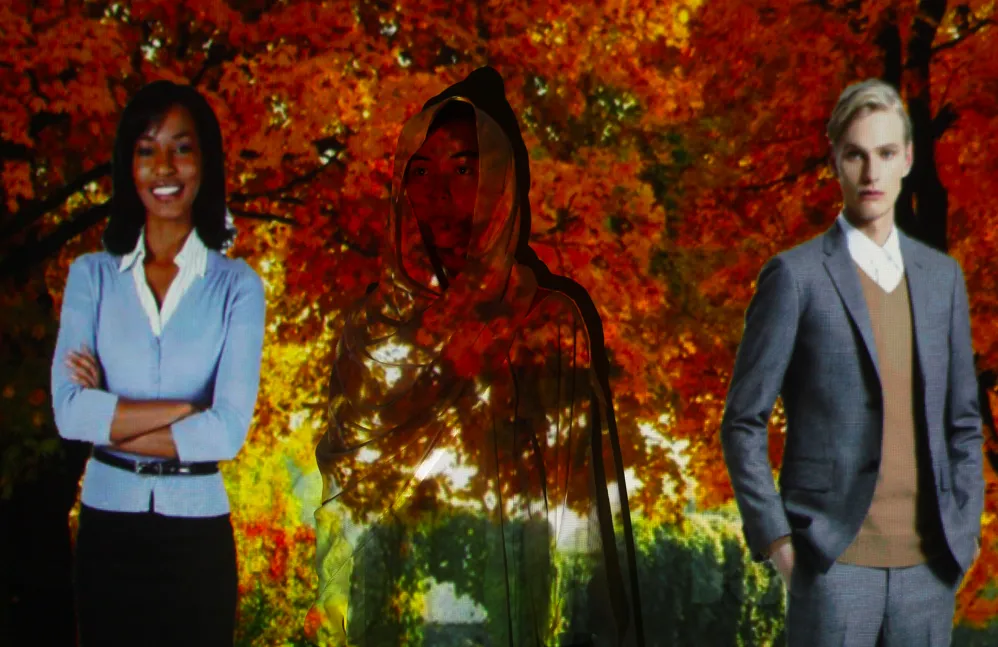 From Rilla Khaled's NEO//QAB project
Speculative Play at the Cultural Margins: Memory, Race, Gender, and Sexuality in the Digital and Virtual Arts
RILLA KHALED & JASON EDWARD LEWIS in conversation with AYANNA DOZIER
Sun. Dec. 4
2 — 3:30pm
As Aimé Césaire astutely asserts in Discourse on Colonialism, the goal of colonization is to reduce bodies to things. Thus, “colonization=thingification.” Objects are things, and as cultural historian Robin Bernstein notes, “performance is what distinguishes an object from a thing.” I would further add to Bernstein’s statement that play---be that gaming, role-play, etc.--- also distinguishes objects from being things. I argue that play is a transformative praxis that enables subjects, specially racialized subjects, to create realties and bodies that dislocate the stillness of fixed racial, gender, and sexual categories in society. In so doing, these individuals use the praxis of play to separate their bodies from the marked label of being a thing in the world.
Play makes room for the absurd, the silly, or what Carla Peterson states as the “empowering oddness” that is used to embody a freedom of movement in the world. Due to this, play (and its sister performance) enables bodies at the cultural margins to restore movement and memory to their lives, histories, and futures. This panel will uniquely draw together artistic and academic researchers to explore and develop the tools of anti-racist practices in the digital arts. Through a roundtable discussion, we aim to investigate how memory might create an alternative approach to game-making, digital creation, and modes of play and performance. What can we learn from virtual realities that allow individuals to create and exist in a malleable timeline? ---Where one can re-start, re-play, and repeat its actions or experiences on an infinite loop. What are the differences between standard modes of gaming and more immersive digital technologies such as virtual reality? If the virtual is not considered a false image but another representation of reality, in Gilles Deleuze’s words, what are the influences of racialized individuals’ cultures and histories in these realities and vice versa? Furthermore, this panel gathers together experts in the field of computation arts, the digital humanities, and the digital arts to discuss how culture affects the way we shape, design, and interpret games, and other digital modes of production, performance, and play.
Ayanna Dozier is a Ph.D. Communication Studies Candidate enrolled in the Institute for Gender, Sexuality, and Feminist Studies’ graduate certificate program at McGill University. She previously received her Masters degree in the department of Media, Culture, and Communication at New York University. Her current doctoral research examines the formal and narrative aesthetics in Black women’s Post Civil Rights experimental films, arguing that formal and narrative aesthetics intersect with the filmmaker’s sociocultural experience to give an account of what gendered Blackness feels like in the world. She has held research fellowships at Marvel Comics and the performance art organization, Performa. Her writing can be found in the Liquid Blackness Journal, International Journal of Comic Art, and Performa Magazine. She currently resides in Montréal, Québec in Canada.
Rilla Khaled is an associate professor at the Department of Design and Computation Arts at Concordia University, and a member of the TAG Lab. Khaled has a PhD in Computer Science from the Victoria University of Wellington in New Zealand. Her research focuses on how to design more effective and meaningful serious and persuasive games, speculative play, the interactions between games, gamification, and culture, participatory game design, and game design and AI. As her background is in software engineering and cross-cultural psychology, her interests extend from the software-level design and development of games up to their higher level effects on and as cultural practices.
Jason Edward Lewis is Full Professor of Design and Computation Arts. He is a digital media artist, poet and software designer. He founded Obx Laboratory for Experimental Media, where he directs research/ creation projects using virtual environments to assist Aboriginal communities in preserving, interpreting and communicating cultural histories, devising new means of creating and reading digital texts, developing systems for creative use of mobile technology. He is the director of the Initiative for Indigenous Futures, a seven-year SSHRC-funded Partnership focused on how Indigenous communities imaging themselves seven generations hence. Lewis co-founded and co-directs the Aboriginal Territories in Cyberspace research network that is investigating how Aboriginal people can participate in the shaping of our digital media future, and co-directs workshop combining traditional stories and game design at the Kahnawake First Nations' high school. He is deeply committed to developing intriguing new forms of expression by working on conceptual, creative and technical levels simultaneously.
Tel que judicieusement affirmé par Aimé Césaire dans Discours sur le colonialisme, le but de la colonization consiste à réduire les corps à l’état de choses. Ainsi, “colonization=chosification.” Les objets sont des choses, et tel que le note l’historien culturel Robin Berstein, “la performance est ce qui distingue un objet d’une chose.” J’ajouterais à la remarque de Bernstein que le jeu — qu’il s’agisse du jeu vidéo, du jeu de rôle, etc. — distingue aussi les objets de leur rôle en tant que choses. J’affirme que le jeu est une praxis transformative qui active les sujets, particulièrement ceux qui sont racisés, pour créer des réalités et des corps qui disloquent la fixité des catégories sociales du genre, de la race et de la sexualité. Du coup, ces individus utilisent une praxis du jeu pour séparer leurs corps de l’étiquette qui marque une chose comme chose étant au monde.
Le jeu rend possible l’absurde, le loufoque, ou bien ce que Carla Peterson appelle la “bizarrerie valorisante” (“empowering oddness”), laquelle peut être outillée pour incarner une plus grande liberté de mouvement dans le monde. En raison de ceci, le jeu (et sa soeur, la performance) active les corps aux marges de la culture pour restaurer mouvement et mémoire à leurs vies, à leurs histoires et à leurs futurs. Singulièrement, ce panel réunira des chercheurs provenant et du milieu des arts, et du milieu académique pour explorer et développer les outils d’une pratique antiraciste dans les arts numériques. Par le biais d’une discussion table ronde, nous espérons investiguer la manière dont la mémoire pourrait créer une approche alternative à la création de jeux, aux créations numériques et aux modes de jeu et de performance. Que pouvons-nous apprendre de réalités virtuelles qui permettent aux individus de créer et d’exister dans une chronologie malléable? Que pouvons-nous apprendre d’une chronologie où nous pouvons re-commencer, re-jouer et répéter nos actions et nos expériences à l’infini? Quelles sont les différences entre les modes standards du jeu vidéo et les technologies numériques immersives telles que la ‘réalité virtuelle’? Si le virtuel n’est pas considéré comme une fausse image mais comme une représentation de la réalité, pour utiliser l’expression de Gilles Deleuze, quelle est l’influence des histoires et mémoires des individus racisés sur ces réalités et vice versa? De plus, ce panel rassemblera des experts du milieu des arts digitaux, des humanités et des arts numériques pour offrir une discussion sur la manière dont la culture affecte la façon dont nous formons, créons et interprétons les jeux et autres modes digitaux de production et de performance.